
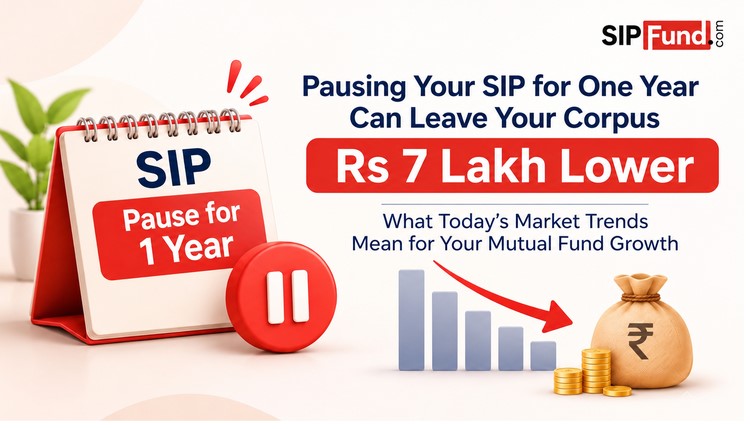
Karthik’s Rs 15,000 monthly SIP could grow to about Rs 75.7 lakh in 15 years, at an assumed 12% return. If he pauses it for one year in year 4, that drops to about Rs 68.5 lakh. The pause leaves his final corpus about Rs 7.15 lakh lower, even though his existing money stays invested.
Karthik, 32, earns Rs 1.2 lakh a month. He read that mutual fund assets fell last month and that investors are rushing into small-cap funds. Now he wonders whether to pause his SIP or chase the hot category. Both instincts are common, and both can be costly.
What Are the Latest Market Trends Telling Karthik?
Let us analyse the facts. AMFI statistics indicate that SIP contributions hit a record of about Rs 32,490 crore in September 2026, and SIP asset totals stood at approximately Rs 17.86 lakh crore, which makes up 21.6% of overall mutual funds’ assets under management.
In September 2026, the net inflow into equity mutual funds amounted to about Rs 38,306.55 crore, 31% more than in August.
Investors also leaned toward riskier equity types. Small-cap funds received the largest share of equity inflows, contributing Rs 9,038.57 crore. Mid-cap funds came second with Rs 7,834.84 crore. Together, these two categories made up about 44% of equity inflows.
Debt funds saw net outflows of about Rs 1.83 lakh crore, mostly from liquid and money market funds (Rs 95,743 crore and Rs 50,846 crore), which often swing around quarter-end. One month of outflows does not show a lasting shift away from debt.
Unfortunately, the markets were not stable during this time. According to the latest statistics, total net AUM in September 2026 was about Rs 82.64 lakh crore. In August 2026, net AUM was at approximately Rs 87.08 lakh crore, which is a decrease of about 5%. Part of that fall reflects the debt outflows above, and part reflects lower market values.
For Karthik, there are two major points. First of all, there is a difference between the flow of money and returns. Money flowing into a category shows investor mood, not performance. The most popular category can still fall. The second point is about SIP stoppages. According to AMFI, 49.68 lakh SIPs were discontinued or matured in September, while 63.26 lakh new SIPs were registered. Some stoppages are SIPs reaching their end date, but the numbers show how many investors lose patience.
Is It Safe to Keep Investing When the Market Falls?
Safety first, return second. The Securities and Exchange Board of India (SEBI) regulates mutual funds in India, and the Association of Mutual Funds in India (AMFI) publishes industry data every month. Regulation governs how the funds are run and what disclosures have to be made. It does not protect against loss.
Equity values fell in September. Karthik should invest in equity only in funds that he would not need for at least five years and ensure that he checks the Riskometer of each scheme before making the investment decision. An SIP helps you with the timing of investment: during the market drop, the same amount gets you more units. A falling market is not a reason to stop; this is when an SIP is worth doing.
What Does Pausing Cost Karthik?
Here is Karthik’s plan with and without a pause starting in year 4. His existing corpus stays invested, but no new money goes in.
| SIP scenario | Total invested | Final corpus (12% assumed return) | Shortfall vs no pause |
|---|---|---|---|
| No pause | Rs 27.00 lakh | ~Rs 75.69 lakh | Rs 0 |
| 6-month pause | Rs 26.10 lakh | ~Rs 72.01 lakh | ~Rs 3.68 lakh |
| 12-month pause | Rs 25.20 lakh | ~Rs 68.54 lakh | ~Rs 7.15 lakh |
| 24-month pause | Rs 23.40 lakh | ~Rs 62.20 lakh | ~Rs 13.49 lakh |
Assumes investment at the start of each month, a constant return and no taxes or costs. Actual returns vary.
By pausing his SIP for one year, Karthik ends up with about Rs 7.15 lakh less. That shortfall already includes the Rs 1.8 lakh he does not invest during the pause; the other Rs 5.35 lakh is the growth those contributions would have earned. The corpus of about Rs 75 lakh that he could have had would help pay for a child’s higher education or a significant part of a flat. Cutting it down by about Rs 7 lakh is a high price to pay.
Which Growth Ideas Can Help Karthik Build More?
Idea 1: Increase SIPs Every Year. If Karthik’s income gets higher, there will be a chance of increasing the SIP accordingly. Take one more example using the same initial sum of Rs 15,000 but increased every year:
| SIP type | Total invested | Final corpus (12% assumed return) |
|---|---|---|
| Flat SIP (Rs 15,000/month) | ~Rs 27.00 lakh | ~Rs 75.69 lakh |
| 5% yearly step-up | ~Rs 38.84 lakh | ~Rs 97.96 lakh |
| 10% yearly step-up | ~Rs 57.19 lakh | ~Rs 1.30 crore |
A 10% yearly step-up means investing more every year, which only makes sense if income grows at a similar pace. These are nominal figures at an assumed return, with no tax or costs. After 15 years of inflation, Rs 1.3 crore will buy much less than it does today.
Idea 2: Use a core-and-satellite approach. While small-cap funds are quite the trend presently, a portfolio built only on a trend can disappoint. For instance, we can take an example of Karthik, who has a target time frame of 15 years: 50% of the investment should be made in Flexi-cap funds and another 30% in Aggressive Hybrid funds. The rest should be allocated to mid- and small-cap funds. Small-cap funds can deliver higher returns but can also fall much further. The proposed mix is just a starting point to have a conversation with a SEBI-registered adviser, not a recommendation.
Idea 3: Review once a year, not every week. Karthik should evaluate once annually whether his portfolio has changed since its last review, and make necessary adjustments in accordance with the latest information. As he nears his target, he may consider shifting some funds from equity to debt investments for safety.
Idea 4: Automate and stay put. The SIP discontinuation figures reflect how difficult discipline can be. Automating the process forces him not to make decisions.
Why SIPfund?
Entering into investing is often daunting. Karthik must pick from dozens of products and finish KYC compliance, all while staying calm when things get ugly. SIPfund’s platform and team support clients throughout the entire process:
- Goal planning: SIPfund will assist Karthik in figuring out how much SIP is needed and will help him plan yearly step-ups.
- Selecting appropriate funds: SIPfund offers a comprehensive list of top-rated funds by category, with scheme documents and past performance shown. Past performance may or may not be sustained in the future.
- Progress tracking: Clients use the platform to monitor investments’ growth, allowing adjustments to the investment strategy over time.
- Support during hard times: The SIPfund team is available to talk when markets drop.
Mutual funds never guarantee returns. What a platform can offer is clarity, discipline and support when markets get uncomfortable.
What Next?
If you are thinking of starting or restarting an initiative to meet your own objectives, take the following three steps:
Step 1: Determine your objective and the amount of money. Decide how much money you want to save and when you will need it. Finally, use the SIPfund platform to determine the suggested SIP and fund mix. The SIPfund team will check your figures, including the step-ups.
Step 2: Manage your automatic SIP. Finish your investor KYC, provide your bank details as well as a nominee, and open an e-mandate in the app. After that, select the desired funds.
Step 3: Remain invested and perform an annual review. Assess your savings, increase your SIP as your income allows, and refrain from pausing the process when markets drop.
Don’t pause what you haven’t started. For Karthik, a one-year pause leaves the final corpus about Rs 7.15 lakh lower. Book a free planning session at +91 95133 55661 / 62 / 63 / 64, or write to info@sipfund.com.
Disclaimer: The information provided in this article is for educational purposes only and does not constitute investment advice or a recommendation to buy or sell any mutual fund. Mutual Fund investments are subject to market risks; read all scheme-related documents carefully. Past performance may or may not be sustained in the future.
Comments (0)
Want to join the discussion?
Log In to Comment