
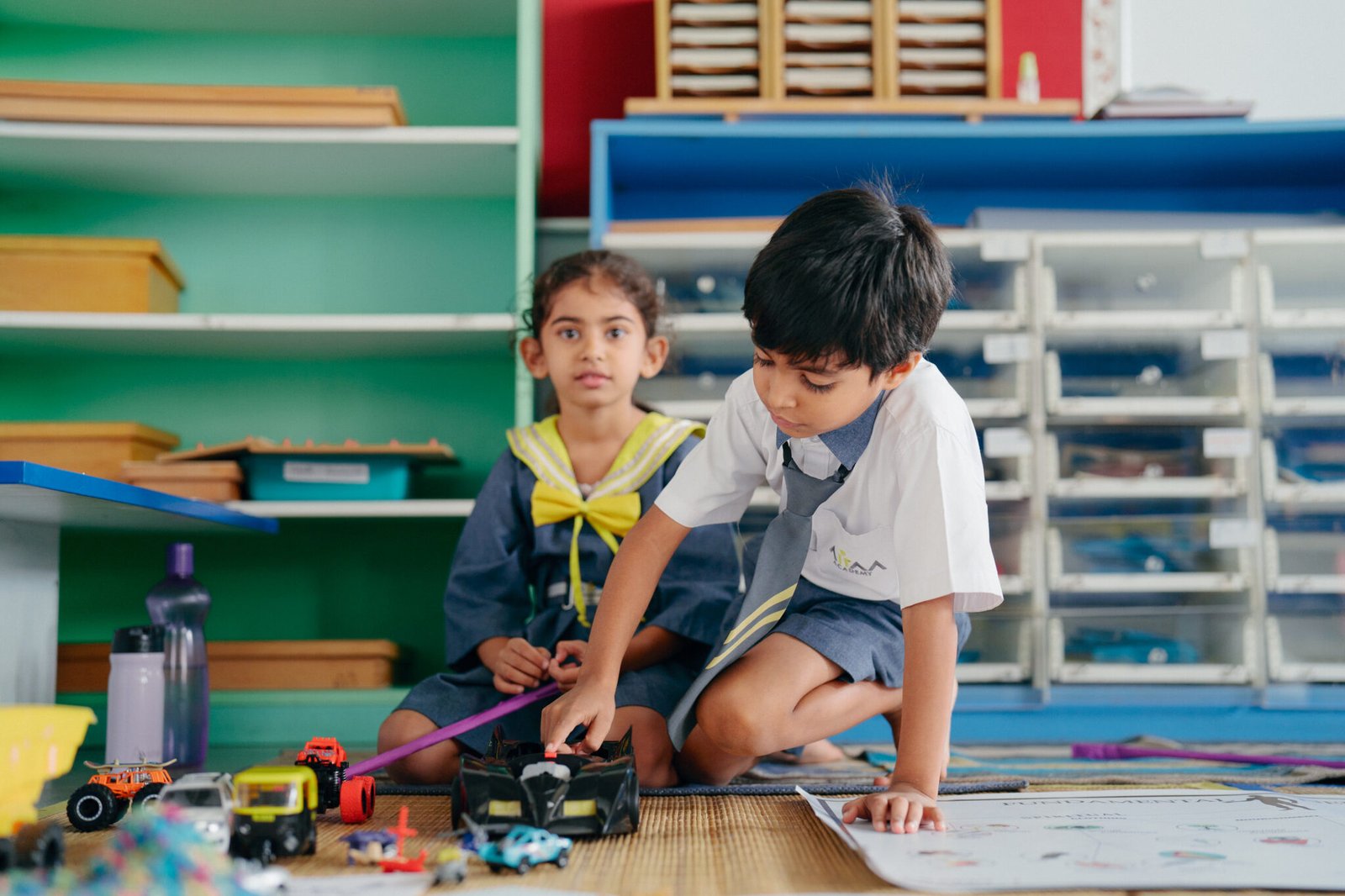
Children do not always develop academic, social, and emotional skills at exactly the same pace. Some may become confident readers earlier, while others show strong interests in mathematics, creativity, or practical activities.
Montessori education recognises these individual differences and provides learning environments designed to support children at various developmental stages.
One distinctive feature of Montessori education is the mixed-age classroom, where learners of different ages share an educational environment.
This approach creates opportunities for independence, collaboration, communication, and meaningful learning experiences.
Understanding Mixed-Age Learning
In a mixed-age Montessori classroom, children from a defined age range learn within the same environment.
Unlike classrooms organised exclusively around a single age group, mixed-age environments provide opportunities for learners to interact with peers who have different experiences and abilities.
Children may work independently, collaborate on activities, or observe others completing tasks.
These interactions can support both academic understanding and social development.
A younger learner may observe how an older peer approaches a learning activity, while an older learner may strengthen understanding by explaining a familiar concept.
Facilitators guide classroom activities according to individual developmental needs rather than assuming every child is ready for exactly the same work.
Learning Through Observation
Observation is an important part of childhood learning.
Children often learn new skills by watching how others perform activities.
In a mixed-age classroom, younger learners may observe older peers working with more advanced materials.
This can encourage curiosity and help children understand what they may be able to explore in the future.
For example, a younger child may watch an older learner complete a mathematical activity involving larger quantities.
The experience can create interest even before the younger child is ready to work with the material independently.
Likewise, observing reading, writing, and practical activities can introduce children to new learning possibilities.
The purpose is not to encourage comparison between children.
Instead, observation becomes a natural part of exploring the learning environment.
Developing Leadership and Responsibility
Mixed-age classrooms can provide meaningful opportunities for older learners to develop responsibility.
As children become familiar with classroom routines and materials, they may help younger peers understand simple activities or participate in collaborative tasks.
Explaining an idea to someone else can also strengthen the older learner's understanding.
These experiences encourage patience, communication, and consideration for others.
Leadership in a Montessori environment does not necessarily mean directing every activity.
It can involve offering help respectfully, sharing knowledge, and recognising when another learner needs space to work independently.
Facilitators guide these interactions to help maintain a positive and supportive environment.
Over time, learners may develop greater confidence in working with different people and contributing to shared activities.
Supporting Individual Learning Progress
Children have different strengths, interests, and developmental needs.
A mixed-age classroom can provide flexibility for learners to revisit earlier concepts or explore more challenging activities when appropriate.
For example, a child who needs additional practice in mathematics may work with familiar materials while continuing to participate in other advanced activities.
This flexibility can help reduce unnecessary pressure to progress at exactly the same pace as peers.
Parents considering an Elementary Montessori school in South Bangalore may want to understand how classroom organisation supports different learning needs.
Facilitators play an important role by observing progress and introducing suitable learning opportunities.
The aim is to support meaningful development rather than measuring every learner against a single timetable.
Encouraging Communication and Cooperation
Learning alongside children of different ages creates opportunities for social interaction.
Learners practise listening, asking questions, explaining ideas, and respecting different perspectives.
Collaborative activities may involve sharing materials, discussing possible solutions, or working together towards a common goal.
These experiences can support communication and cooperation.
Children also learn that different people contribute different strengths to a group.
Younger learners may bring curiosity and fresh questions, while older learners may offer experience and guidance.
However, effective collaboration requires appropriate boundaries and facilitator support.
Children should have opportunities to work independently as well as participate in group experiences.
This balance helps preserve individual learning needs while encouraging positive relationships.
What Parents Should Understand About Mixed-Age Classrooms
Parents exploring Montessori Schools in Bangalore may have questions about how mixed-age education works in practice.
During a school visit, families can ask about the age range within each classroom, how learning activities are selected, and how progress is monitored.
It is also helpful to understand how facilitators support children who need additional assistance or are ready for more challenging work.
Parents can observe whether children are comfortable participating in activities and how the classroom encourages respectful interaction.
A mixed-age environment should not mean that all children receive identical activities.
Instead, the learning approach should recognise individual readiness and provide appropriate guidance.
Airaa Academy, located in Banashankari 6th Stage, Kengeri Hobli, Bangalore, includes mixed-age learning experiences within its Elementary Montessori approach.
The value of mixed-age education comes from providing opportunities for children to learn independently while also benefiting from meaningful interactions with others.
Through observation, cooperation, and shared experiences, Montessori classrooms can support the development of confidence, responsibility, and respect for individual differences.
Comments (0)
Want to join the discussion?
Log In to Comment