
Industrial moulds and dies are exposed to demanding conditions during manufacturing. High temperatures, repeated contact with materials and continuous production cycles can make surface protection an important part of equipment maintenance. When a mould begins to experience material sticking or uneven release, manufacturers may need to review their coating selection and application practices.
Hexagonal Boron Nitride (hBN) coatings are among the materials considered for such requirements. Their ceramic structure and dry-lubricating properties make them suitable for certain processes where conventional oils and greases may not provide the desired performance.
One practical decision manufacturers face is choosing between white and blue hBN coating formulations. At first, the difference may seem purely cosmetic, but the appearance of the coating can affect how operators inspect treated surfaces during preparation.
Before choosing a coating, it is important to understand the actual problem. In aluminium extrusion, for example, tooling is exposed to heat and contact with aluminium. Suitable coatings may help manage material adhesion and provide a protective release layer. In die casting, a coating may be evaluated to help reduce sticking between processed metal and compatible mould surfaces.
These applications require careful attention to surface preparation. If a die contains old residues, dust or contamination, the coating may not adhere or spread as intended. Even a suitable formulation can produce inconsistent results when the application procedure is not followed correctly.
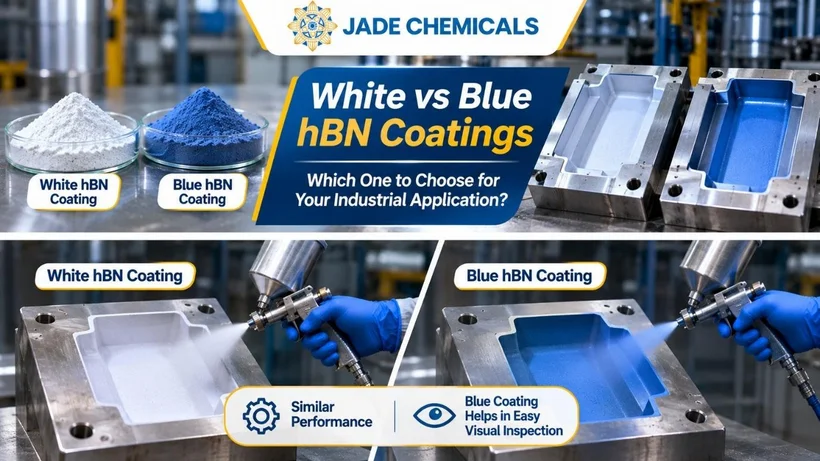
White hBN coatings offer dry lubrication and release properties for appropriate industrial applications. They can be selected where their natural appearance is suitable for the process and inspection requirements. The coating should still be applied according to the manufacturer's recommendations, with attention to coverage and drying conditions.
Blue hBN coatings introduce a visible colour that may help operators identify treated areas. This is particularly useful when working with complex moulds or components containing grooves and multiple surfaces. A contrasting colour can make it easier to notice areas that appear to have been missed during application.
This visual difference should not be confused with improved lubrication performance. Colour is only one characteristic of the finished formulation. Manufacturers must still evaluate thermal performance, surface compatibility and the requirements of the production process.
Another consideration is repeatability. When several operators work on the same production line, coating procedures need to be clear and consistent. Using a defined application method, checking the surface before treatment and inspecting the coating before operation can help reduce differences between production shifts.
A blue formulation may support visual checks during this process, but it cannot replace proper training or inspection. Coating thickness and adhesion may require additional assessment, particularly when the application is sensitive to variations in film quality.
Jade Chemicals offers JD Nano-BNC80 White Coating and JD Nano-BNC80 Blue Coating as part of its industrial lubrication and coating range. The company identifies both variants as providing equivalent intended thermal protection, dry lubrication and anti-stick performance, with the blue option incorporating a pigment for easier visual identification.
Manufacturers looking for a direct comparison can read White vs Blue hBN Coatings: How to Choose the Right Coating for Industrial Applications. This guide explains the characteristics of both formulations and discusses their relevance to different manufacturing processes.
Information about the available formulations can also be found on the Hexagonal Boron Nitride Coatings product page.
For an industrial buyer, selecting the right coating should involve more than comparing product descriptions. The team should review the tooling material, operating temperature, expected contact conditions, application instructions and maintenance requirements.
Where possible, a controlled application trial can help determine whether the selected formulation and process are suitable before wider implementation. The results should be assessed against practical production requirements rather than relying on appearance alone.
A suitable hBN coating, supported by good preparation and consistent application, can help manufacturers manage tooling surfaces more effectively. Whether white or blue coating is selected, the important consideration is how well the formulation fits the actual manufacturing environment.
Comments (0)
Want to join the discussion?
Log In to Comment