
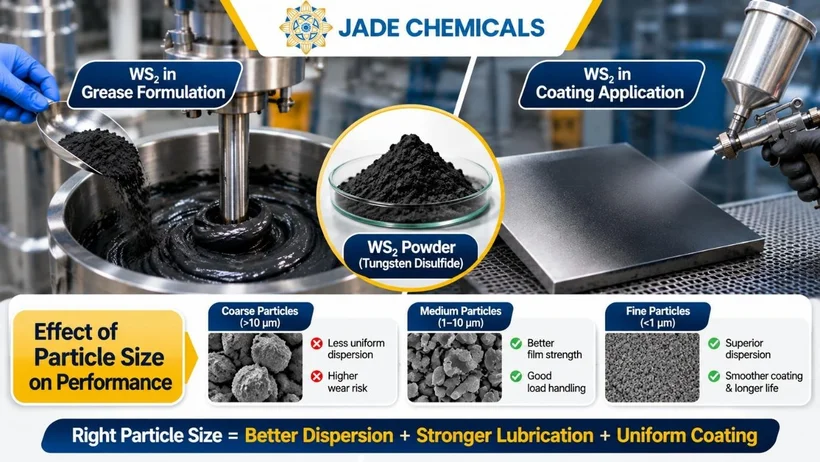
In industrial lubricant manufacturing, selecting the right raw material is only the beginning. How that material is stored, handled and prepared before mixing can also influence the consistency of the finished product. This is particularly important when working with specialty solid lubricants such as Tungsten Disulfide (WS₂) powder, which is used in grease formulations, dry-film coatings and other industrial applications.
WS₂ powder is known for its layered crystal structure and friction-reducing characteristics. Manufacturers use it in suitable formulations to improve surface lubrication and help control wear under demanding operating conditions. However, the effectiveness of a finished lubricant depends on more than the properties of the powder itself. Particle size, material cleanliness, dispersion and manufacturing practices all deserve attention.
For companies developing industrial greases and coatings, maintaining consistent powder quality throughout the production process is an important part of formulation control.
Why Proper WS₂ Powder Storage Matters
Industrial powders are often purchased in quantities that may be used across several manufacturing batches. During this period, the condition of the stored material needs to be maintained.
Poor storage practices can expose raw materials to dust, moisture or other contaminants. Damaged packaging and repeated handling may also introduce unwanted material into the powder.
Contamination can create difficulties during formulation, particularly when manufacturers require controlled particle distribution and consistent finished-product properties.
A practical storage approach begins with following the supplier's recommended conditions. Containers should remain properly identified, and the material should be protected from unnecessary exposure during storage and handling.
Manufacturers should also review the applicable safety data sheet before establishing storage and handling procedures.
How Handling Practices Influence Particle Dispersion
Particle size is an important consideration when selecting WS₂ powder for grease and coating applications.
Fine particles have a relatively large surface area compared with their mass, and their behaviour during mixing can differ from larger particles. Depending on the formulation, fine powders may form agglomerates that need to be addressed through suitable dispersion methods.
Material handling can influence how consistently the powder is introduced into the manufacturing process.
For example, adding powder too quickly may create localised concentrations that are difficult to distribute evenly. The appropriate addition rate and mixing procedure depend on the formulation and production equipment.
When developing a grease, the objective is to incorporate WS₂ powder consistently into the base oil, thickener and other additives. The finished formulation should then be assessed for the properties required by its intended application.
A coating manufacturer faces a different challenge. The powder needs to work with the binder and other formulation ingredients to produce a suitable film on the treated surface.
In both cases, controlled handling and mixing are important for repeatable results.
Why Particle Size Should Be Checked Before Formulation
Not every WS₂ powder grade is suitable for every lubricant application.
A manufacturer developing a thin dry-film coating may require different particle characteristics from a company producing grease for heavy-duty industrial machinery.
Fine particles may be considered when coating thickness and surface uniformity require careful control. However, smaller particles do not automatically deliver better lubrication performance.
Dispersion quality, particle-size distribution and compatibility with the complete formulation also matter.
Micron-sized WS₂ powder may be suitable for other applications where the selected particle characteristics work effectively with the processing method.
This is why manufacturers should review technical specifications before choosing a material.
Jade Chemicals provides multiple WS₂ powder grades, including 90 nm, 0.6 µm, 1.5 µm, 4.5 µm and 12.5 µm, allowing formulation teams to evaluate options for different industrial requirements.
Maintaining Quality During Grease Manufacturing
Grease production involves combining ingredients that must work together under the intended operating conditions.
When WS₂ powder is used as a solid lubricant additive, the manufacturing process should support consistent distribution throughout the finished grease.
Uneven mixing may result in variations between samples or production batches. These differences can make product testing and quality control more difficult.
Manufacturers should therefore document important processing conditions, including the order of ingredient addition, mixing procedure and any relevant processing adjustments.
The finished grease may need evaluation for consistency, mechanical stability, oil separation and lubrication performance, depending on its intended use.
It is also useful to compare production batches using the same testing methods. This helps identify variations that may require further investigation.
Storage and Mixing Considerations for Industrial Coatings
Dry-film coating formulations have their own requirements.
A coating must provide suitable surface coverage, adhesion and performance under its intended operating conditions. WS₂ particle characteristics can influence the finished film, particularly where coating thickness needs to be controlled.
If powder particles are poorly dispersed, the coating may develop unwanted surface irregularities. The selected binder, substrate preparation and application method can also influence the result.
Manufacturers should evaluate the complete coating formulation rather than assuming that the powder alone determines performance.
Material handling procedures should support consistent preparation, while coating tests should assess properties relevant to the intended application.
For thin coatings, particle-size distribution and agglomeration deserve particular attention.
Choosing WS₂ Powder for Consistent Industrial Production
When purchasing specialty lubricant powder, price is not the only consideration.
Manufacturers should review the available technical specifications, particle-size options, purity requirements and suitability for their formulation process.
Documentation and batch identification can also help production teams maintain traceability.
Jade Chemicals supplies specialty solid lubricant materials for industrial grease manufacturers, coating formulators and engineering applications.
Companies looking for a Tungsten Disulfide (WS2) Powder supplier in India can explore the available particle-size grades and discuss their manufacturing requirements before selecting a material.
For additional guidance, Jade Chemicals has published a detailed article explaining how WS₂ powder particle size affects industrial grease and coating formulations.
Selecting the right powder is an important decision, but maintaining consistent material quality requires attention throughout the manufacturing process. Suitable storage, careful handling, controlled mixing and practical formulation testing can help manufacturers achieve more repeatable results.
For industrial businesses, these practices provide a stronger foundation for developing grease and coating products that meet their intended performance requirements.
Comments (0)
Want to join the discussion?
Log In to Comment