
A sliding guide may operate thousands of times during a normal production shift. At first, its movement is smooth and consistent. After months of service, the equipment may begin making unusual noises, moving less freely or showing visible marks along the contact surfaces.
These changes often develop gradually.
Industrial machinery contains many components that move against one another, including sliding guides, mechanical linkages and selected positioning mechanisms.
Where repeated contact occurs, friction and wear can become important maintenance concerns.
The right lubrication approach depends on the component design, load, operating environment and type of movement.
What Happens During Repeated Metal Contact?
Even polished metal surfaces are not completely smooth.
Under magnification, they contain small irregularities that interact when components move against each other.
Repeated movement under load can contribute to surface wear.
Depending on the materials and operating conditions, this may involve adhesive wear, abrasion or other surface damage.
As the contacting surfaces change, friction may become less predictable.
In precision machinery, changes in movement can interfere with positioning accuracy. In heavy equipment, surface damage can increase maintenance requirements.
Lubrication is one method used to manage these interactions.
Why Sliding Guides Need the Right Lubricant
Not all sliding mechanisms operate under the same conditions.
Some move slowly while carrying substantial loads. Others make frequent short movements or operate near heated production equipment.
A guide exposed to airborne dust may also face contamination problems.
The lubricant must be selected according to these conditions.
Conventional oils and greases are appropriate for many industrial sliding systems, particularly where the equipment manufacturer specifies them.
However, certain applications may benefit from specialised dry-film lubrication.
The choice should be based on the actual requirements of the mechanism rather than assuming that one lubricant type suits every situation.
Understanding the Role of WS₂ Dry-Film Lubrication
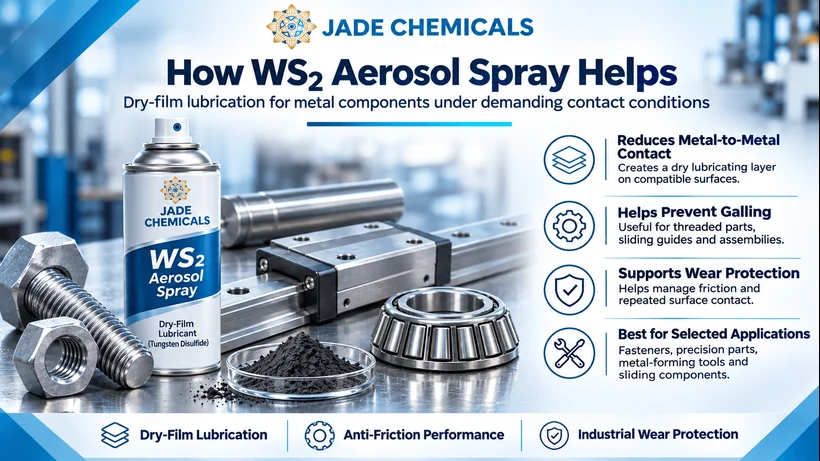
Tungsten Disulfide (WS₂) is a solid lubricant known for its layered crystal structure.
Under suitable conditions, these layers can slide relative to one another, giving the material useful low-friction properties.
WS₂ can be used in different lubricant and coating systems.
In an aerosol formulation, it may be deposited onto compatible surfaces to create a relatively thin lubricating layer.
This can be useful for selected assemblies where a thick grease layer is undesirable or difficult to apply.
However, the performance of a WS₂ aerosol depends on the complete formulation, coating adhesion and operating conditions.
It should not automatically replace an oil-lubricated guide or a grease-filled bearing.
Warning Signs of Sliding Surface Wear
Maintenance teams can look for several changes that suggest closer inspection is needed.
Uneven movement: A mechanism that previously moved smoothly may begin sticking or requiring greater force.
Surface scoring: Visible scratches or lines may indicate contact damage.
Unexpected noise: Squeaking, grinding or other unfamiliar sounds can suggest changes in surface interaction.
Increased vibration: Irregular movement may contribute to changes in vibration.
Repeated lubrication problems: Components that require unusually frequent attention may need a review of the lubrication method.
These symptoms can have several causes, including alignment errors, contamination and mechanical damage.
Lubrication should be investigated alongside the condition of the equipment.
Surface Cleanliness Makes a Difference
A dry lubricating film performs best when the surface has been prepared according to the product instructions.
If oil, dirt or damaged coating remains on the component, the new film may not adhere consistently.
The preparation method depends on the material and the coating formulation.
It is also important to check clearances, existing wear and the suitability of the coating thickness.
A thin-film lubricant cannot restore the original dimensions of a severely worn component.
Where extensive damage has already occurred, repair or replacement may be necessary before lubrication improvements are evaluated.
Evaluating WS₂ Aerosol Spray for Sliding Components
Before applying a new lubricant across several machines, manufacturers can test it on a suitable component.
The trial should reflect the expected load, speed, operating temperature and contact materials.
Teams can compare movement, surface condition and maintenance observations before and after the application.
A product that performs well in one assembly may require different evaluation in another.
For businesses seeking a Tungsten Disulfide (WS2) Aerosol Spray supplier in India, Jade Chemicals provides information on WS₂-based dry-film lubrication and its potential applications for metal components.
Jade Chemicals, based in Bengaluru, supplies specialty lubrication products for industrial and engineering applications across India.
Repeated sliding wear is best addressed before it becomes severe. Monitoring surface condition, maintaining mechanical alignment and choosing an appropriate lubricant can help reduce avoidable maintenance problems.
A carefully evaluated dry-film coating may form part of that approach where the equipment design and operating conditions support its use.
Comments (0)
Want to join the discussion?
Log In to Comment