
GTM Strategy: What It Is, Who Needs It and How to Build One
A business decides to enter a new market. The team starts discussing a website, social media campaigns, email outreach and hiring a salesperson.
All of these may be needed. But there are a few decisions to make first. Who exactly are we trying to sell to? What do these customers need? Why would they consider us? What should we offer, and how much should we charge?
These questions form the starting point of a Go-to-Market strategy.
What is a GTM strategy?
GTM stands for Go-to-Market. It is the plan a business prepares before entering a new market, expanding into a new geography or launching a product or service.
The purpose is to work out how to reach the right customers, give them a reason to buy and deliver what we promise.
Let’s take a simple example.
Imagine a website development company in India planning to work with hospitality businesses in Australia. This is an illustrative example, but it shows the decisions involved.
The company knows how to build websites. It now needs to understand which businesses to approach.
- Should it focus on independent hotels, resorts or restaurant groups?
- Who makes the decision?
- What would make them consider replacing their existing website?
- It also needs to decide its pricing
- How it will show relevant work and how it will manage communication across time zones.
Working through these questions is part of building its GTM strategy. The plan begins before entering the market and develops as the business learns from customers.
Who needs a GTM strategy?
A startup needs one when it is preparing to find its first customers. An established business needs one when it changes what it sells, who it sells to or where it operates.
For example:
- A local business expanding into another city.
- A manufacturer introducing a new product.
- A consultancy entering another country.
- A software company moving from small businesses to enterprise customers.
- A company introducing a subscription alongside its existing services.
Even a business already running campaigns may need to revisit its GTM strategy if it keeps attracting enquiries that do not fit its offer.
Being able to deliver a service and knowing how to sell it in a new market are two separate things to work out.
How is it different from a marketing strategy or marketing plan?
These terms overlap, but they answer different questions:
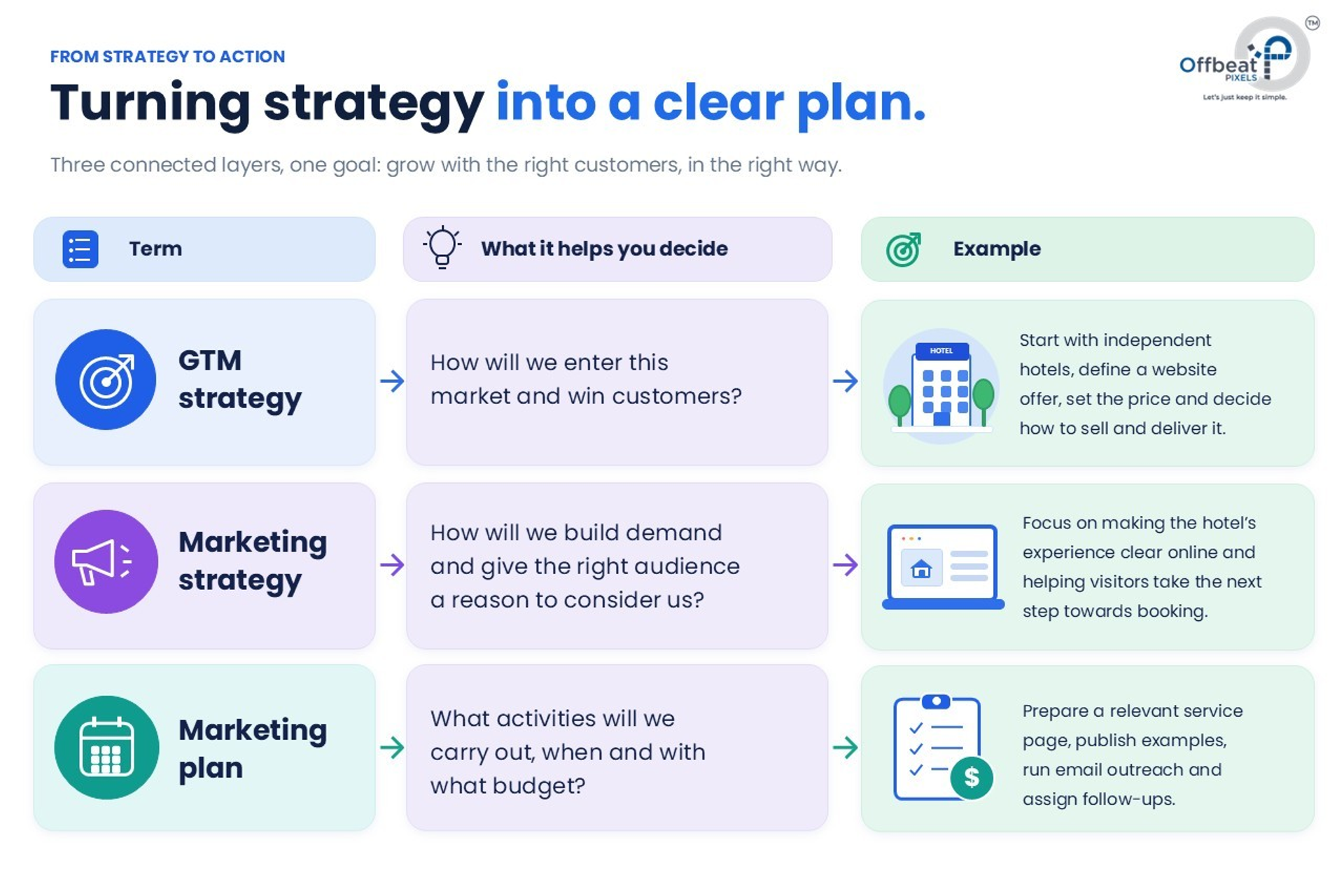
Difference between GTM strategy, marketing strategy & marketing plan
How do you build a GTM strategy?
I would start with six questions.
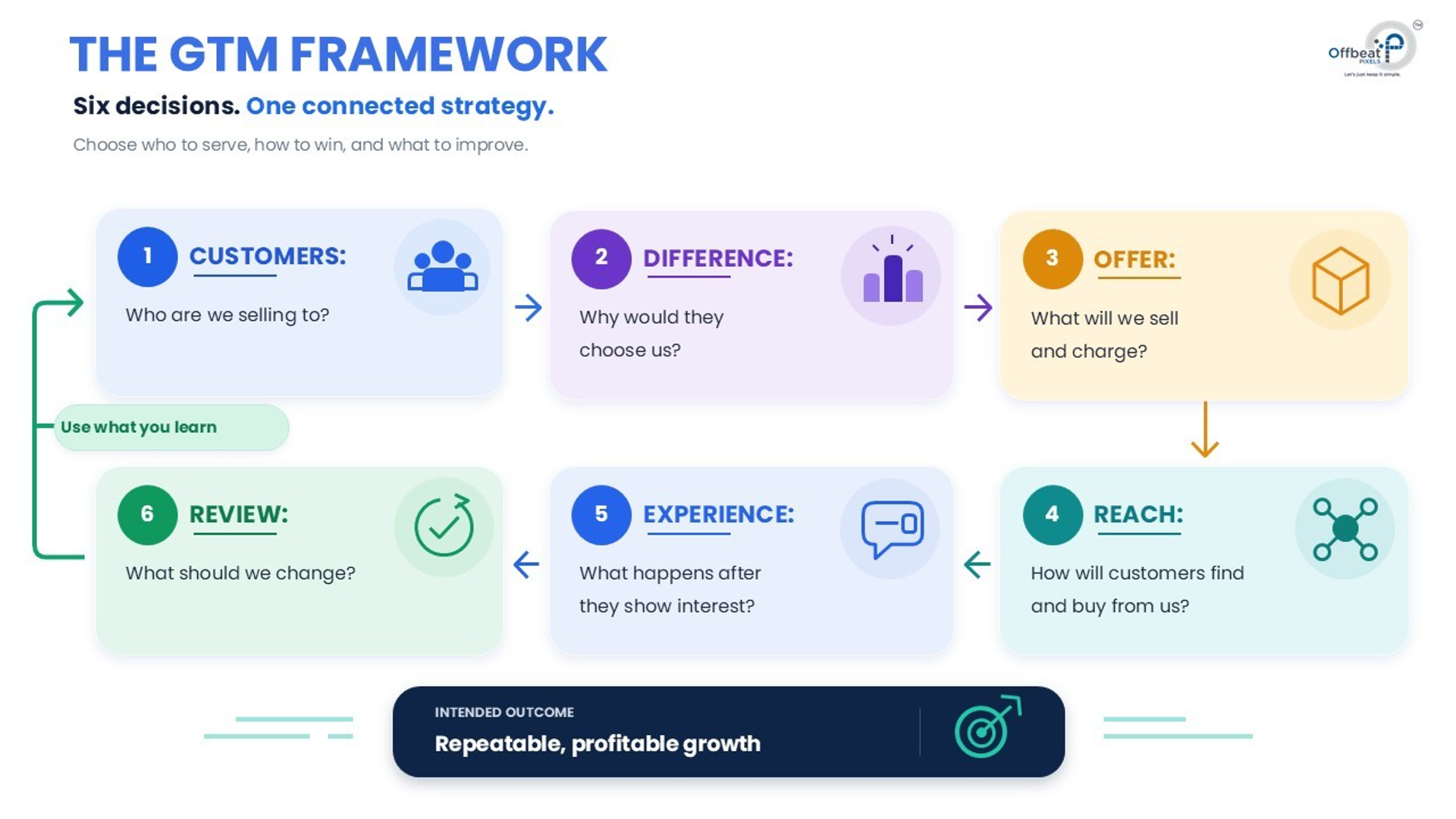
1. Customers: Who are we selling to?
- Begin by understanding the market. Look at customer needs, available alternatives, competitors and whether there is enough demand to justify the effort.
- Then choose a manageable starting group. Dividing a broad market into smaller groups is called market segmentation. For our website company, “Australian hospitality businesses” is still broad. An independent hotel and a large hotel chain may have different budgets, approval processes and support needs. The company could choose to investigate independent hotels first, then speak to owners and managers about their current websites and priorities. Perhaps their concern is maintaining the website. Perhaps it is presenting the property properly. Perhaps their booking process needs attention. Research should establish the need before the campaign assumes it.
- Common mistake: choosing an audience based only on industry or location.
- What to check: who has a relevant problem, who controls the budget and who is willing to discuss a paid solution.
This gives the next decision a clearer foundation: why those customers should choose you.
2. Difference: Why would they choose us?
Look at what customers can already buy and how competitors present their services. Read customer feedback and ask prospects what they like or dislike about their current provider. The aim is to find a useful difference you can actually deliver. “We build beautiful websites” leaves plenty of questions unanswered. A more specific offer could explain how the company presents rooms and facilities, connects the booking journey and makes future updates easier. Those claims need to match its capabilities and work examples. This is your value proposition: a clear explanation of the benefit you offer and why it matters to the customer.
- Common mistake: describing your capabilities without explaining their value to the buyer.
- What to check: whether prospects understand the offer and what reasons they give for choosing or rejecting it.
That understanding should shape your website copy, emails and sales conversations.
3. Offer: What will we sell and charge?
- Define what the customer receives, what it costs and what happens after they buy.
- For a website project, that includes the pages, content responsibilities, booking-system integration, revisions, delivery timeline and support.
- Pricing needs to account for the work involved, the customer's alternatives and the costs of winning and serving the customer.
- If you charge per page, explain what a page includes. If integrations or ongoing maintenance cost extra, make that clear before the proposal becomes a negotiation.
- Common mistake: offering a low starting price while leaving the actual scope unclear.
- What to check: how often customers ask for discounts, where extra work appears and how much remains after delivery costs.
These decisions help you work out how much you can afford to spend acquiring a customer.
4. Reach: How will customers find and buy from us?
- Find out where your audience looks for providers and how it prefers to evaluate them.
- Your approach might involve search, email outreach, referrals, local partners or direct sales. A physical product may also need retailers or distributors.
- For the website company, an email could introduce the offer, a relevant page could explain it, and a call could help both sides decide whether the project is a good fit.
- Each step needs to make sense from the customer's point of view.
- Common mistake: opening several marketing channels without the time or resources to manage them properly.
- What to check: which channels bring suitable enquiries, what it costs to win a customer and how long the decision takes.
This tells you where to invest and what information buyers need next.
Read More: OffbeatPixels
Comments (0)
Want to join the discussion?
Log In to Comment