
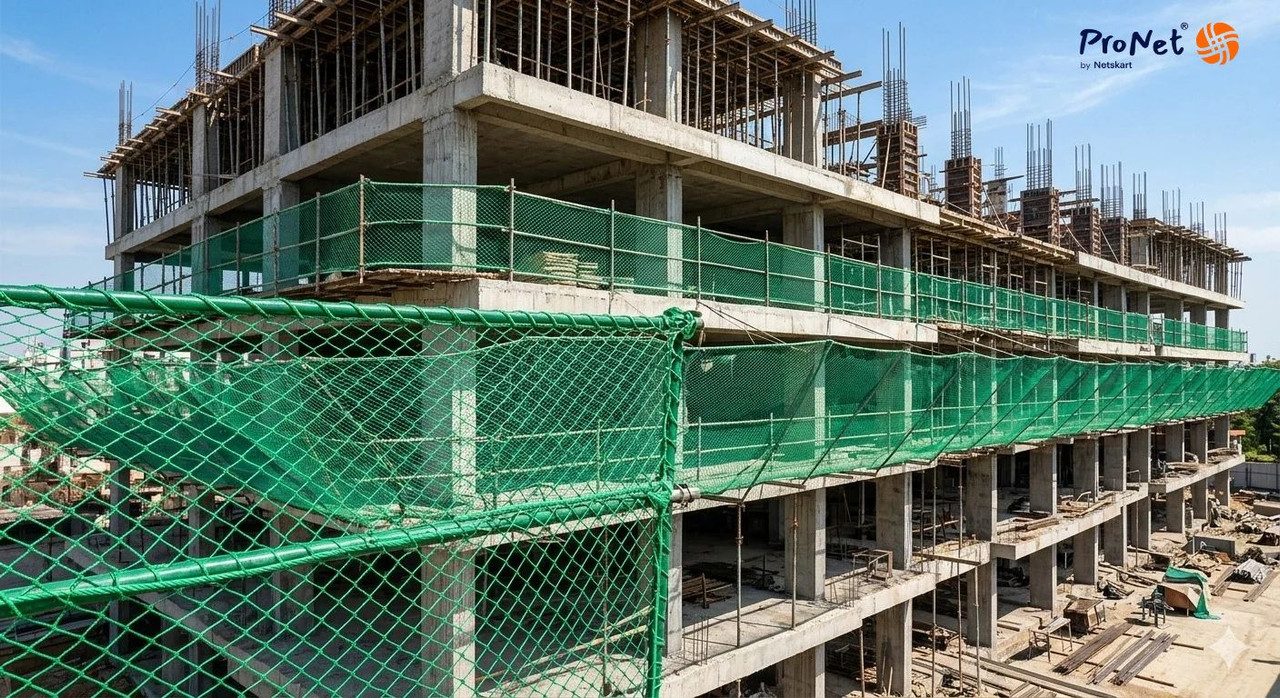
Falls from height remain one of the most serious risks on any building site. Scaffolds, open floor edges, shafts and facades all create situations where a single slip can cause a serious injury. A construction safety net is one of the most effective passive protections available, because it works without depending on a worker remembering to clip on or follow a procedure. This guide explains how these nets work, what to check before buying, and how to install and maintain them so they perform when it matters.
What a Construction Safety Net Actually Does
A safety net is a strong, flexible barrier that catches people or falling objects and absorbs the energy of the fall. Unlike a rigid guardrail, it gives slightly under load, which reduces the impact force on the body. Nets are used in two main ways: as personal fall protection, placed below the work area to catch a worker, and as debris protection, placed around the structure to stop tools, bricks and loose material from reaching people below.
Where Safety Nets Are Used on a Site
- Building facades and scaffolds: Vertical nets stop debris from dropping onto the street or neighbouring property.
- Open floor edges: Horizontal or angled nets protect workers on upper slabs and shuttering levels.
- Stairwells and lift shafts: Nets close dangerous openings during construction.
- Roof and steel structure work: Nets below the working level catch falls during erection and sheeting.
- Bridges and flyovers: Nets protect both workers and traffic below.
Key Factors When Choosing a Net
Material
Most construction nets are made from high-density polyethylene (HDPE) or nylon. HDPE is light, resistant to moisture and rot, and can be UV-stabilised for long outdoor use. Nylon offers high energy absorption and is often chosen where fall arrest is the main requirement. The right choice depends on whether the net is for fall protection, debris catching or both.
Mesh Size
The mesh must be small enough to stop the objects it is meant to catch. A larger mesh may be acceptable for fall arrest, but debris protection needs a tighter mesh so small items do not pass through. Always match the mesh to the hazard rather than choosing one size for the entire site.
Strength and Rope Quality
Strength is determined by twine thickness, knot type and the border rope around the net. A weak border rope is a common failure point, because the load is transferred through it to the anchor points. Check that the net is supplied with a reinforced border and that its strength rating suits the height and the weight it may have to catch. Look for products that are tested against the relevant standards, such as IS 11057 for industrial safety nets in India.
UV and Weather Resistance
Sites are exposed to sun, rain and dust for months. A net without UV stabilisation can lose strength well before it looks worn, so request information on UV treatment and expected service life.
Installation Basics
Even a high-quality net can fail if it is installed poorly. Keep these points in mind:
- Anchor points: Fix the net to structural members that can carry the load, not to temporary or weak supports.
- Tension: The net should be taut but not overstretched, so it can still absorb energy when loaded.
- Overlap and gaps: Join panels securely and leave no openings at corners or edges where a person or object could slip through.
- Height and clearance: Place the net as close under the work area as practical, with enough free space below so a falling person does not strike the ground or structure when the net deflects.
- Competent supervision: Installation should be carried out by trained people who understand fall protection.
Inspection and Maintenance
A safety net should be checked before use, after any fall or heavy impact, and at regular intervals. Look for cuts, burn marks, damaged knots, fraying border ropes and signs of UV ageing. Remove debris that has collected in the net, because it adds weight and can hide damage. A net that has caught a fall should be taken out of service until it has been inspected, and replaced if there is any doubt about its condition.
Common Mistakes to Avoid
- Buying purely on price without checking material, strength and UV treatment.
- Using one net type for every hazard on the site.
- Fixing the net to weak anchor points.
- Leaving gaps between panels or along edges.
- Skipping regular inspections once the net is installed.
Planning Procurement for Larger Projects
For multi-storey projects, plan net requirements early. Measure each protected area, decide where fall protection and debris protection are needed, and order a little extra for corners and overlaps. Working with a supplier that handles bulk orders and custom sizes helps keep the schedule on track. If you are comparing options, you can review the details of a construction safety net supplier in India to see what to ask for in terms of specifications and delivery.
Final Thoughts
A construction safety net is not a replacement for good planning, training or other protective measures, but it is one of the most reliable layers of defence on a building site. Choosing the right material and mesh, installing the net correctly and inspecting it regularly together make the difference between a net that looks fine and one that actually protects. If you are searching for a construction safety net near me in Jaipur, you can learn more about protective netting solutions at Reach Nettings.
Comments (0)
Want to join the discussion?
Log In to Comment